
Hello, welcome to our Winter 2026 newsletter.
Contents
- England – A Centre of Light
- The Pentacle & the Apple
- Samhain & the Celtic New Year
- Sandhill Wood & its Notable Features
- Insight from the Winter Solstice
- Charitable Donations
1. England – A Centre of Light
E.F. Morley. Kosmon Unity. Autumn 1951
At a time when I was reflecting on the chaotic state of the world, wondering how this situation could be resolved, I came across the following striking trance address given by Chief Minister Frank Morley to members of the Kosmon Church in 1951. The message is clear: England has the power to “guide Mankind toward a new kingdom”. We have the historical example of this in the abolition of slavery, initiated by Wilberforce, Thomas Clarkson and others, which spread around the world. Thomas Clarkson gathered evidence about slavery and inspired support for change, travelling throughout the country for many years. (BBC Reith Lecture no.2 December, 2025)
Here is the trance address by Frank Morley:
England – A Centre of Light
Ancient Britain was one of the world’s great centres of occult learning. Great Initiates from Egypt and Persia are known to have visited this, the land shaped like a triangle. The early body of Druids were the custodians of the Ancient Wisdom. All these “wise ones of eld” gradually imparted to the very life of this country a mighty power, which has been passed down to all the peoples who have lived on these shores, so that they possess it both as a general sense of a national characteristic, but also in a more individual sense as an occult force.
It was this ancient power which as a national characteristic of a will to power made the English race create the greatest empire the world has ever known. Since, however, that empire was obtained mostly by bloodshed or theft, with the coming of this New Age, it has had to go; but from it a Commonwealth has arisen, which may in time be the foundation for the Brotherhood of Nations.
We, however, are not concerned with politics, saving to watch with interest the gradual unfolding of the Plan of Light. It is the fact that an esoteric power rests in this island that closely concerns us, especially when we regard England as half-way between the Orient, region of ancient illumination, and the Occident, the land of promise for the future.
The important thing for us to remember is that as a Centre of Light, England still stands in the forefront. From certain areas a power radiates which, if rightly directed, can guide Mankind towards a new kingdom, not made by weapons, but forged from stone and iron, copper, silver and gold. That is to say, built in beauty and truth, by the powers of spirit, and the light of the soul.
And so today, England again arises, no longer a major military or political world power, but a leader of those who journey to the creation of an ideal community, dedicated to honouring The One All Light.
We shall see how this country’s inherent creative power, which gave rise to, for example, the industrial revolution, football, and English as a universal language, can be the agent for the spreading of light and harmony in today’s world.
2. The Pentacle & the Apple
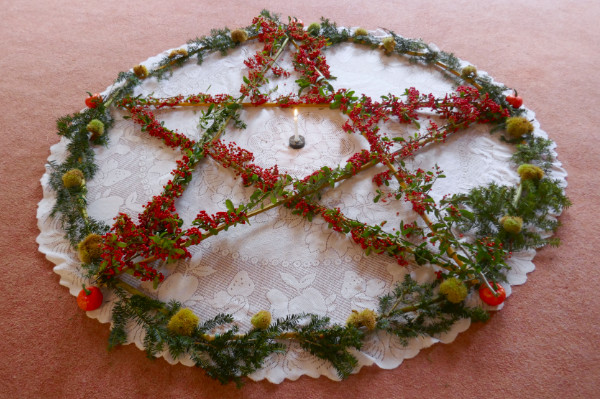
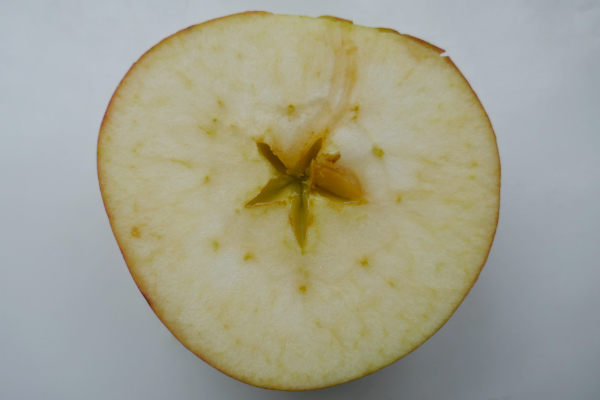
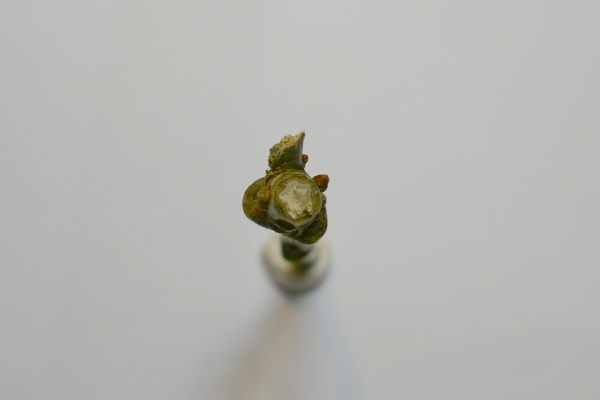
The Pentacle – 5-pointed star
The Celts honoured the pentacle since it is present in the transversely cut apple, which they deeply venerated. The pentacle is also to be seen in cut oak twigs (see photos above.)
The pentacle symbol has been around since the Stone Age. It is amongst the few ancient symbols that are still highly popular today.
One meaning of the pentacle is that it is “a sign of love, life, light, unity, enlightenment, and a quest for divine knowledge.” Mythologian.net/pentacle
We can see the Human Being in this symbol, the arms, legs, and head touching the circle, which represents the universe/unity.
We may also view the five contact points as the 5 elements, with spirit at the top. This view emphasises the connection of the earth with the universe, represented by the circle.
The pentacle has been a powerful symbol of protection in many cultures for thousands of years.
Celtic Awareness of the Qualities of the Apple
The Celts believed that apples had the qualities of immortality, wisdom, love and links to the Otherworld.
At Samhain, (end of Oct/ beginning Nov.) the boundary between the physical worlds and the Otherworld is thin, so that the qualities of the apple were particularly evident then, e.g. for fortune telling and rituals for divination, especially concerning love and marriage. The most prominent ritual at Samhain was bobbing for apples when the challenge was to attempt to take a bite out of an apple floating in water or hanging from a branch.
This was courtship ritual which derived from a belief in the occult qualities of the apple. For predicting marriage, the first person in the group to successfully bite an apple was believed to be the next person in the group to marry. For forecasting relationships, each floating apple was assigned the name of a potential suitor. A young woman would attempt to bite the apple corresponding to her crush. Getting it on the first try meant a perfect match; two tries predicted a short -lived romance; three or more meant the relationship was ill-fated.
3. Samhain & the Celtic New Year
To understand Samhain as experienced by the Celts, we need to remember that this was an agricultural community. Awareness of the seasons and their prevailing climatic conditions was central to their daily living experience: planting, harvesting, moving livestock etc.
“Samhain is at the end of October/beginning of November. Autumn has reached its peak now; the harvest is all gathered in. The days are getting shorter and Winter is almost upon us. We return again to the reflective realms inside ourselves for regeneration of Spirit, rest, and contact with our inner wisdom”. (Sacred Celebrations. Glennie Kindred, p10)
The date of Samhain, November 1st, lies between the Autumn Equinox on September 21st and the Winter Solstice on 21st December. In September there are warm light days that belong to Summer, while cold and darkness is the experience of December. The weather presents hints of sun and the cold to come. This coming darkness signifies the Celtic New Year, the reason for which is very interesting.
The Celts had a circular view of time. The day started at sunset, i.e. with the arrival of darkness, and completed at the following sunset. The year was viewed in the same way, starting with darkness. Samhain, which marks the advent of darkness on November the 1st, is recognised as the date of the New Year, not January 1st.
Why this emphasis of darkness as the place where cycles start? Our culture views the coming of light as holding the potential for new creative beginnings, whether it be the start of a day or the coming of Spring. However, darkness is the natural time for reflection since the creative energy of the sun is low. Reflection and meditation in the evening of a day may well give us clarity as to what future work needs to be done and thus set the course of events during the day. In this sense, the day actually begins in the evening. Likewise, reflection in Winter may well provide focus for the nature of our creative activity in the light half of the year.
4. Sandhill Wood & its Notable Features
Sandhill Wood, on a high part of the North Downs, is part of the grounds of The Kosmon Sanctuary. It comprises 22 acres of ancient woodland, which were once part of medieval Walton Manor. As the name suggests, the soil is of sand. There are also round pebbles and, at a deeper level, chalk with flints. Round pebbles tell us that, in distant geological time, this land was once underwater.
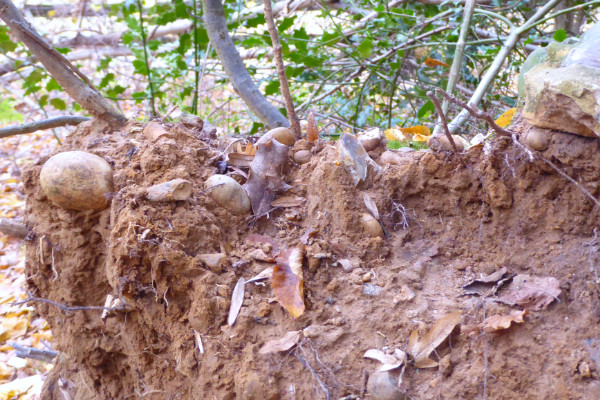
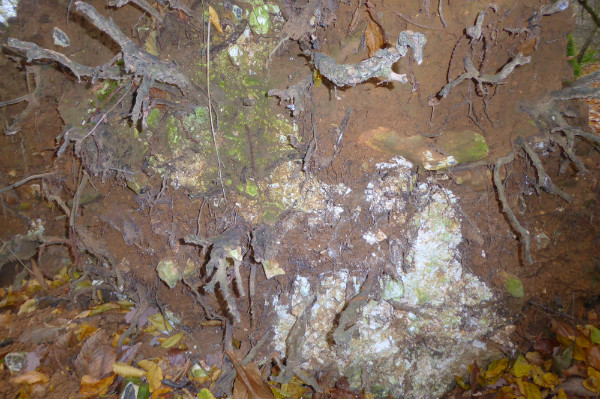
Notable features in Sandhill Wood
Ancient Earthworks

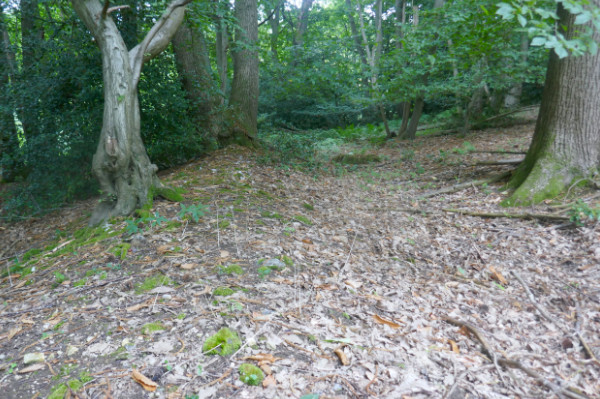
Ancient earthworks are to be found in Sandhill Wood. Most are to be found on the eastern and southern boundaries, though there are earthworks within the wood itself. All earthworks in Sandhill Wood are symmetrical.
Symmetrical earthworks are thought to be ancient field boundaries, rather than woodland boundaries, which were usually asymmetrical, i.e. formed with one side longer than the other. (1.) This suggests that our earthworks once defined the boundaries of medieval fields, which were allowed to return to woodland to supply wood for Walton Manor. This would explain the presence of much formerly coppiced sweet chestnut, hornbeam, hazel, and oak.
Reference
(1.) The Cultural Heritage of Woodlands in the South East. Dr Nicola R. Bannister.
Yew Tree Circles


Sandhill Wood has several yew trees.
There is nothing unusual in this, of course, but what is striking is that in our case, many of the yew trees are formed into circle-like patterns of four, five or seven trees. The seven tree circle actually comprises a circle of six trees, with one in the centre. Judging by their girth, the trees in this circle are roughly 150 years old.
Someone in the Victorian period planted these circles, though one can only guess as to the reason. Possibly, the aim was to create a strong field of yew-tree energy. One has only to stand in the centre of one of the circles to experience this yew tree energy: very grounded and strong with a sense of its own identity and the continuity of life.
These qualities are expressed in the way the tree grows. Nothing grows under a yew tree. It exists in its own space, projecting a strong sense of its own power. Moreover, the lower branches of the mature tree touch the ground, root, and create a circle of new trees, which grow and blend with each other and the parent tree. Thus, the source of life perpetually renews itself, indeed the Druids regarded the yew tree as the tree of eternity.
Oak Trees & Energy Centres


Dowsing
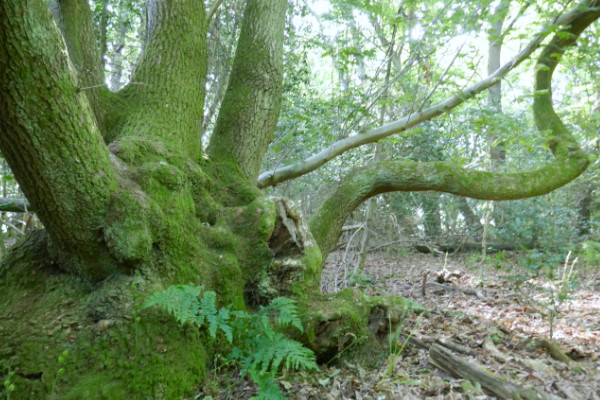
We use the movement of dowsing rods held in the hands as our criterion of energy, e.g., when approaching oak trees growing normally with straight trunks, there is no movement of the rods. However, there is a distinct movement in the rods when approaching an oak tree growing with twisted branches.
The phenomenon of trees growing with twisted branches has been described for Juniper trees growing at high-energy sites in Sedona, Arizona.
5. Insight from the Winter Solstice
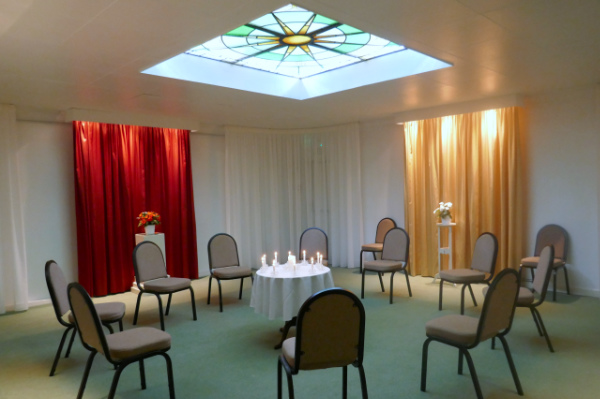
We arranged a circular table in the centre of The Sanctum with a candle in the centre. Around the circumference of the table were candles, one for each member of the group.
Key understanding – The Winter Solstice is a special time in which we reflect on the events of the past year, and in the stillness, become aware of our sense of direction in the creative energy of the New Year.
5 minutes silence – We reflected in the silence as to what creative seeds we wished to plant and nurture in the coming time of increasing light.
Candle lighting – As each person lit their candle using a taper, they expressed their intension aloud for the coming creative time. With eye contact, they then passed on their taper to their neighbour.
Co-creating with the Higher Powers
The Higher Powers will support our creative aspirations. During the following visualisation, we silently expressed our wish for guidance in fulfilling our creative wish.
We visualised the coming together of our group on the physical plane with the higher powers. Our physical plane was symbolised by the circle of lights. The light of the higher powers was symbolised by the illuminated zodiac in the ceiling. Both lights were visualised as coming together in the stillness of the room.
6. Charitable Donations
Each month we donate to charities, mostly local, whom we wish to support in their valuable community work.
Royal Marsden Cancer Charity: We are concerned with the development of world-leading cancer treatment.
St. Mungo’s Homeless Charity: Supports increasing numbers of the homeless on the streets.
ActvLives is a charity working in Ipswich and across Suffolk to keep people active, connected, and involved with the local community.
PlayWise Learning CIC (Community Interest Company) offers a range of services and interventions for children aged 0-8with additional needs or disability.
Stripy Stork: We are a baby bank who collects and redistributes baby and children’s items to families who are experiencing hardship.
Street Vet: We provide veterinary care and services to pets of people experiencing homelessness.
We also donate to the Trussell Trust and their work with foodbanks and The Salvation Army.