
Our ancient woodland is known as Sandhill Wood and, as the name suggests, has sandy soil. It is the original woodland of Walton Manor, which retains a medieval structure internally but has Victorian buildings externally.
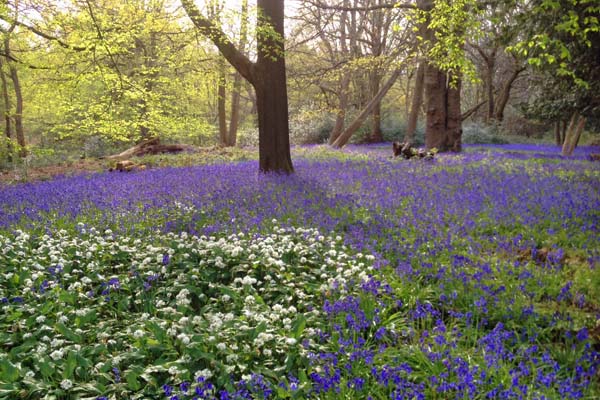
The undulating ground and wide variety of trees of our beautiful ancient woodland offer ever-changing vistas and surprises. Some trees are very old, while the circles of yew trees, planted many years ago, invite the visitor to enter and experience a deep stillness. Any person or group wishing to be in contact with the natural world, for study, meditation, reflection or simply peaceful walking, will gain much from being here. The local Forest School for young children is a regular user of the woodland, as well as other children’s groups and drumming groups.
Yew Tree Circles in Sandhill Wood
Sandhill Wood has several yew trees. There is nothing unusual in this, of course, but what is striking is that in our case, many of the yew trees are formed into circle-like patterns of four, five or seven trees. The seven-tree circle actually comprises a circle of six trees, with one in the centre. Judging by their girth, the trees in this circle are roughly 150 years old. Someone in the Victorian period has planted these circles, though one can only guess as to the reason.
Possibly, the aim was to create a strong yew tree field of energy. One has only to stand in the centre of one of the circles to experience this yew tree energy: very grounded and strong with a sense of its own identity and the continuity of life. These qualities are expressed in the way the tree grows. Nothing grows under a yew tree. It exists in its own space, projecting a strong sense of its own power. Moreover, the lower branches of the mature tree touch the ground, root, and create a circle of new trees which grow and blend with each other and the parent tree. Thus, the source of life perpetually renews itself, indeed the Druids regarded the yew tree as the tree of eternity.


Oak Trees as Indicators of Earth Energy
A few oak trees in Sandhill Wood grow with twisted branches, sometimes with an enlarged base trunk. By dowsing, we find that these oak trees grow in places of high energy. We use the movement of dowsing rods held in the hands as our criterion of energy: when approaching oak trees growing normally with straight trunks, there is no movement of the rods. However, there is a distinct movement in the rods as they approach an oak tree with twisted branches.
The phenomenon of trees growing with twisted branches has been described for Juniper trees growing at high-energy sites in Sedona, Arizona.


Earthworks in Sandhill Wood
Ancient earthworks are to be found in Sandhill Wood. Most are to be found on the eastern and southern boundaries, though there are earthworks within the wood itself. All earthworks in Sandhill Wood are symmetrical. Symmetrical earthworks are thought to be ancient field boundaries, rather than woodland boundaries, which were usually asymmetrical, i.e. formed with one side longer than the other. (1.) This suggests that our earthworks once defined the boundaries of medieval fields, which were allowed to return to woodland to supply wood for Walton Manor. This would explain the presence of much formerly coppiced sweet chestnut, hornbeam, hazel, and oak.
(1.) The Cultural heritage of woodlands in the South East. Dr Nicola. R. Bannister

Creating Habitats in Sandhill Wood
Clear spaces have been created in the woodland to provide a habitat for wild flowers and the insects and birds that rely on them. Hazel coppicing has been re-established, dead hedging has been provided for nesting birds, hedgehogs and insects, and a pond has been created, which has already proved popular with deer and birds.

